



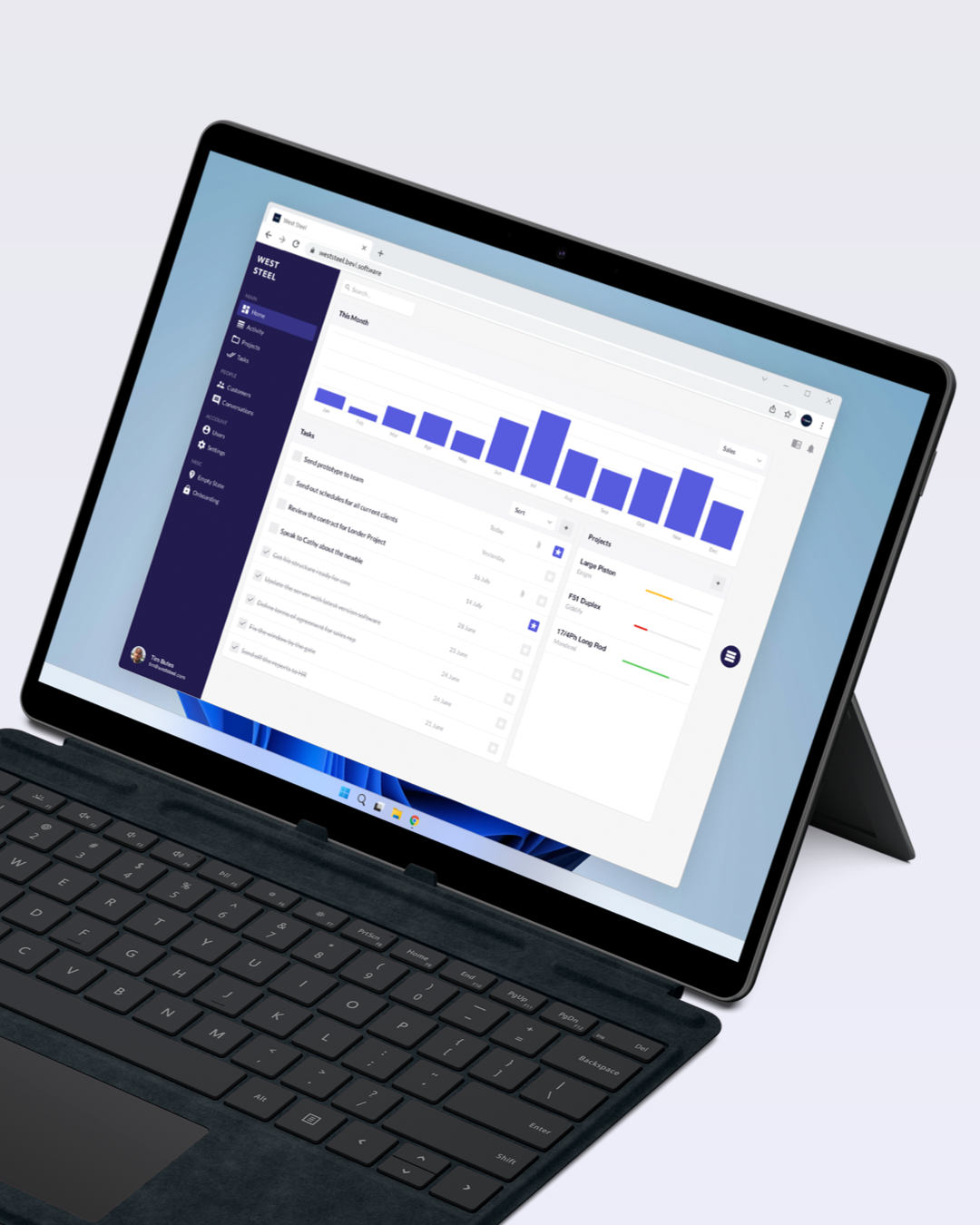
West Steel stocks rare metals for the hydraulics industry — precision stock, specialist customers, no room for looking disorganised. But internally, sales ran the way it does in a lot of growing companies: everyone's own to-do list, on paper, on the desk they happened to be sitting at that day. Fine when the team was small enough that everyone just knew what everyone else was doing. Past a certain size, nobody could actually see it anymore — only guess at it.
We built a shared task list the whole sales team works from, so a task belongs to the company, not to whoever's notepad it started on. Everyone can see what a teammate's already picked up, what's been chased and what hasn't, without needing to ask. Tasks can carry more than one person where a job genuinely needs it — an engineering spec check and a sales follow-up on the same order, both visible to each other rather than running in parallel and blind. Managers get a live view of sales activity and open work across the team, not a monthly roundup stitched together after the fact. It runs the same on a phone as it does at a desk, so nobody's stuck waiting to get back to the office to check what's moving.
Our customers deal in precision stock — they notice if we're not on the same page. Now we always are.
Now, a task is visible to the whole team the moment it exists — not just to whoever wrote it down. A customer gets one call, from whoever's actually handling their order, because the team can see who that is.
As the sales team's got used to working from one shared list, the conversation's moved toward connecting it more closely with engineering's own workflow — so a spec check doesn't just get flagged to sales, it's visible on the engineering side too.
Thirty minutes, no pitch — bring whatever's breaking, even if it's just a screenshot.
